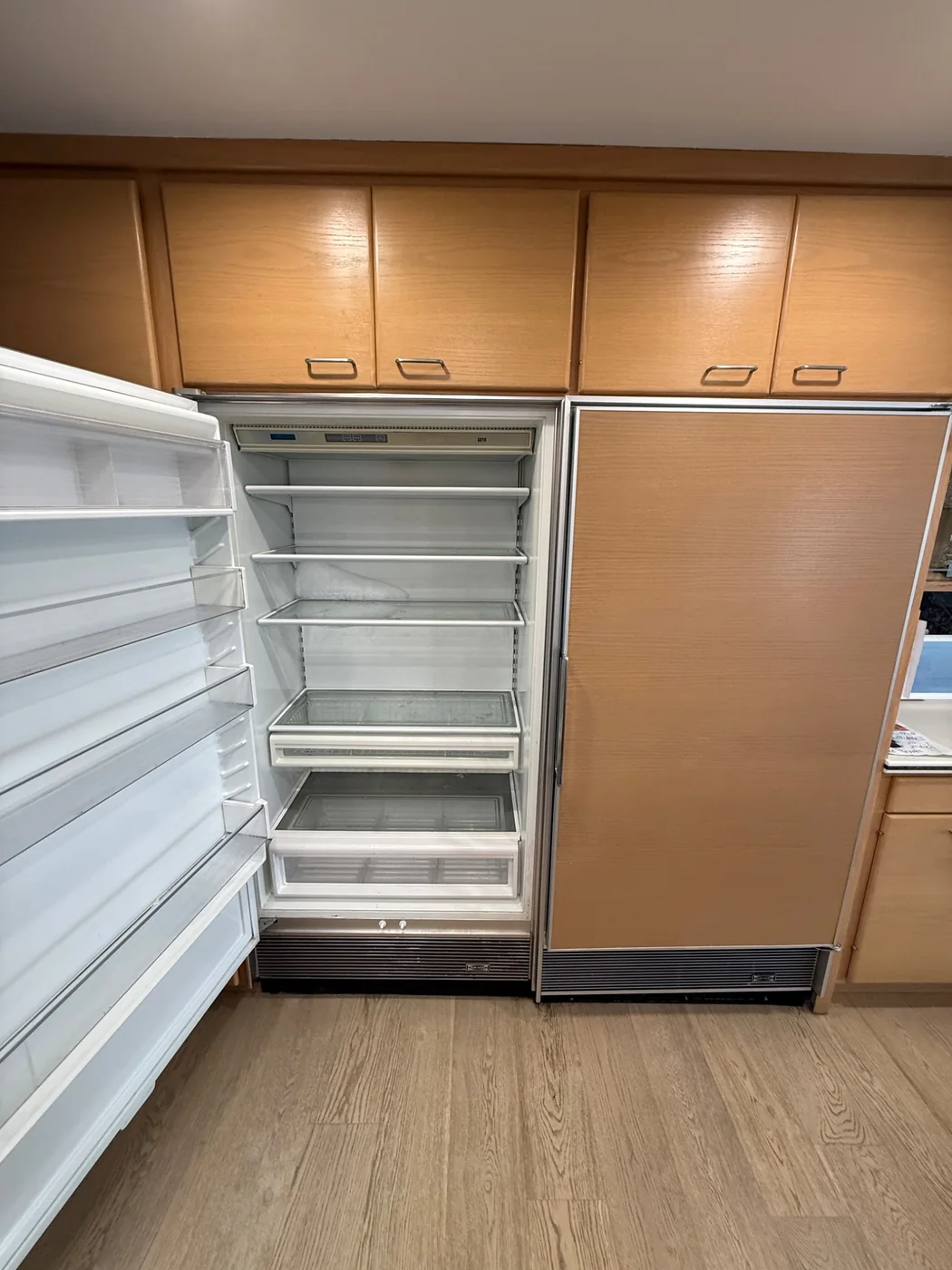
Before anything else: water and a built-in appliance are a bad combination for the room, not just the appliance. Sub-Zero units sit inside custom cabinetry, and meltwater running under the base goes straight into the subfloor and the cabinets around it. The repair is usually minor. The water damage, if it sits for weeks, is not.
The short answer: it is the drain
On the units we open in Seattle and on the Eastside, a blocked defrost drain accounts for the large majority of leak calls. It is also the cheapest thing on the list to fix, which is why it is worth understanding before you assume something expensive has failed.
How the defrost drain actually works
Your refrigerator makes frost on purpose. The evaporator — the cold coil hidden behind the back panel — collects frost as it pulls humidity out of the air. Several times a day the unit runs a defrost cycle: a heater warms that coil just enough to melt the frost off it.
That meltwater has to go somewhere. It runs down into a small trough, through a drain opening, down a plastic tube, and lands in a shallow pan underneath the unit, sitting near the compressor. The compressor is warm, so the water evaporates from the pan and the cycle starts again. Done properly, you never see a drop of it.
Now block that tube. Meltwater backs up in the trough with nowhere to drain. It refreezes into a plug, the plug grows with every cycle, and eventually water spills over the edge of the liner — onto the freezer floor first, then out the door and onto yours.
What blocks it
The tell-tale signs it is the drain
- Ice on the freezer floor, especially a flat sheet under the bottom basket. This is the stage before water reaches your kitchen floor.
- Water appears at the front, under the door, rather than at the back or along one side.
- It comes and goes on a rhythm of hours rather than constantly — that rhythm is the defrost cycle.
- Cooling is still fine. A drain problem does not usually change temperature, which is exactly why people live with it for months.
What else can leak
The drain is the first suspect, not the only one. Four others are worth knowing, because where the water shows up narrows it down quickly.
The ice maker and its water line. Water at the back of the unit or along one side, often with a change in ice production at the same time. The fill valve, the supply line fitting or a cracked line behind the unit.
The drain pan. Plastic that has spent fifteen years cycling between warm and cold eventually cracks. Water then appears under the middle of the unit with no ice anywhere inside.
Door gaskets. A gasket that no longer seals lets warm humid air in continuously. That shows up as condensation running down the inside walls and heavier-than-normal frost, alongside the puddle.
The condensate pan overflowing. If the compressor area is not shedding heat properly — usually a dirty condenser — the pan stops evaporating fast enough and simply fills up.
What you can safely do before calling
- Find where the water actually starts. Dry everything, then watch for a few hours. Front, back or center tells us more than the size of the puddle.
- Empty the bottom basket and look for an ice sheet. If it is there, you have almost certainly found your answer.
- Try warm water down the drain opening. It sits at the back of the freezer floor, usually under a small cover. Warm — not boiling — poured slowly. A soft plug often clears.
- Check the condenser grille at the top. Dust there causes several problems at once, and clearing it is free.
- Note the model and serial number. Inside the door frame or behind the kick panel. It tells us the drain layout before we arrive.
Do not push a wire down the drain tube. It is soft plastic, and a puncture turns a fifteen-minute cleaning into a component replacement inside the cabinet. Same for boiling water on a cold liner. If warm water does not clear it, the blockage is deeper than a home fix reaches.
What the repair involves
On a service visit the drain gets cleared properly and then flushed and tested through an actual defrost cycle — because a line that runs clear once can still close again if the underlying blockage is only partly gone. If the tube has been punctured by a previous attempt, or has slipped out of the pan, it is replaced.
We document these jobs: the wine cooler drain line case is the same fault on a different unit, and it is the cheapest job on that page while preventing the most expensive damage.
When it is not worth waiting
Water under a built-in reaches the subfloor and the cabinet sides long before it becomes obvious. If the unit is integrated into cabinetry — as most Sub-Zero installations here are — the cabinetry is worth several times the repair. That is the reason to treat a small puddle as a scheduling matter rather than a someday matter.
Frequently asked questions
Sometimes, and carefully. Flushing warm water down the drain opening at the back of the freezer floor clears a soft ice plug in many cases. What causes damage is forcing a wire or a coat hanger down the tube: the drain line is soft plastic and puncturing it turns a routine cleaning into a component replacement. Never use boiling water on a cold plastic liner either. If warm water alone does not clear it, the blockage is further down and needs proper equipment.
Almost always the same blocked drain. Meltwater from each defrost cycle has nowhere to go, so it refreezes at the lowest point — a sheet of ice under the bottom basket. That ice sheet is the stage before water on your kitchen floor: once it builds past the lip of the liner, the next cycle sends the overflow out the door.
There is no fixed schedule, but on units we service the drain is the single most common maintenance item. Kitchens with heavy use, frequent door openings or a lot of produce see debris reach the drain faster. If you have had one blockage, it is worth having the drain checked at the next service visit rather than waiting for the second flood.
Not medically, but it is a clock. Water sitting under a built-in runs into the subfloor and the surrounding cabinetry — and on a Sub-Zero that cabinetry is usually custom cabinetry worth more than the repair. Pull the unit out if you safely can, dry underneath, and get it looked at before the next defrost cycle adds more.
It can, and the location tells you a lot. Drain problems produce water at the bottom of the unit and often ice under the freezer basket first. Ice maker problems — the water line, the fill valve or the fitting behind the unit — usually leave water at the back or along one side, and the ice production itself often changes at the same time.